
Inside the FBI-DOJ Breach: When Zero Trust Lies Fail
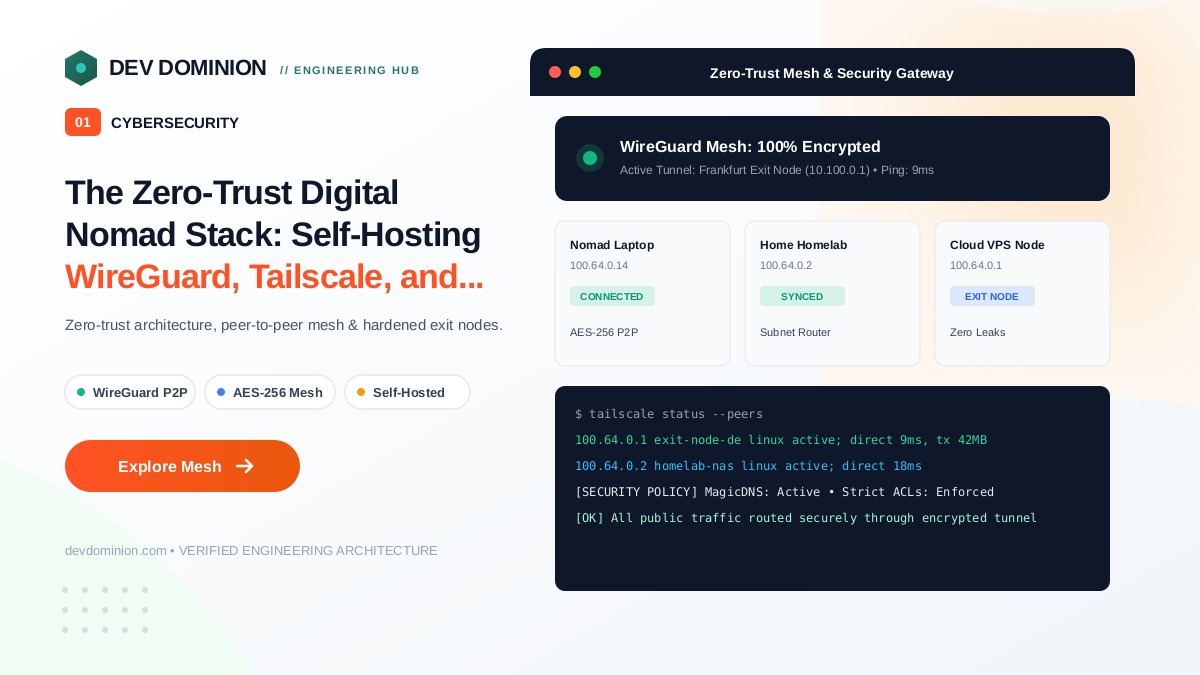
I was sitting in a corner café in Split, parsing through telemetry logs over a hardened WireGuard tunnel, when the alert hit my private feed. The Department of Justice issued an urgent internal bulletin: the breach previously believed to be contained inside the FBI's perimeter has breached cross-agency boundaries. It now impacts Justice Department employees directly.
Predictable. Infuriating. Entirely preventable.
For the past four years, federal directives like OMB Memorandum M-22-09 have trumpeted the government's transition to a strict Zero-Trust Architecture. Executive orders were drafted. Billions in taxpayer cash flowed to legacy defense contractors who slapped "Zero-Trust Compliant" stickers onto twenty-year-old appliance boxes. Yet here we are. A hostile entity punched through the Bureau's perimeter, found the connective tissue between two of the most sensitive law enforcement bodies on Earth, and hopped the fence.
Let's dissect what actually happened under the hood, why federated identity is the soft underbelly of modern enterprise security, and how you can audit your own infrastructure before your tokens end up on a dark-web paste site.
The Incident: How an Isolated Intrusion Became a Federal Emergency
Initial disclosures framed the incident as a localized compromise of external-facing FBI equipment—the usual PR scrub language designed to soothe lawmakers. Agencies love phrases like "isolated incident" and "no indication of broader compromise."
Crickets.
Then the ground shifted. A classified notice obtained by Politico revealed the grim reality: the adversary didn't stop at the Bureau's front door. They leveraged existing architectural relationships to siphon data spanning broader Department of Justice personnel records. We're talking about active duty special agents, federal prosecutors, high-clearance analysts, and administrative staff whose real identities are critical operational secrets.
If you've spent any time designing identity systems for distributed remote teams—something we obsess over while engineering private infrastructure on Dev Dominion—you already know how this movie ends. The problem wasn't a sophisticated quantum-decrypting superweapon. The problem was identity federation, excessive implicit trust, and architectural rot disguised as operational convenience.
Under the Hood: Deconstructing the Cross-Tenant Identity Pivot
How does an intruder break into the FBI and suddenly find themselves reading DOJ databases? To understand this failure, you have to look past the firewalls and stare directly into the messy mechanics of enterprise identity synchronizations.
1. The Golden SAML and Token Theft Mechanism
Modern federated enterprises link disparate directories using Security Assertion Markup Language (SAML) or modern OpenID Connect (OIDC) trusts. The DOJ serves as the parent entity, while components like the FBI, DEA, and ATF operate semi-autonomous identity silos. To allow an agent to access shared justice databases, these directories rely on trust relationships backed by digital signatures.
Here is the attack chain that repeatedly haunts these hybrid setups:
- Initial Compromise: Attackers compromise an edge gateway, unpatched appliance, or a contractor workstation with access to the internal network.
- Credential Harvesting: Once inside, the adversary dumps local memory (via LSASS inspection or token-stealing infostealers) to capture active Kerberos tickets or Primary Refresh Tokens (PRTs).
- Signing Key Exfiltration: In worst-case scenarios—reminiscent of the SolarWinds Nobleium playbook—attackers access the Active Directory Federation Services (AD FS) token-signing certificate or cloud application registration secrets.
- Arbitrary Assertion Generation: With the signing certificate in hand, an attacker can mint their own valid SAML assertions. They don't need user passwords. They don't care about SMS two-factor prompts. They can forge an identity claim asserting they are a senior Justice Department administrator, sign it with the compromised Bureau key, and hand it to the DOJ authentication endpoint.
The downstream identity provider sees a cryptographically valid token signed by a trusted partner. It opens the vault. It never suspects a thing.
2. The Perils of Unconstrained Forest Trusts
Many government systems still run on legacy on-premises Active Directory topologies tied together by two-way transitive forest trusts. If Domain A trusts Domain B, Kerberos ticket-granting tickets (TGTs) issued in one environment can frequently be exchanged for service tickets in another unless strict SID filtering is enforced.
Adversaries hunt for service accounts configured with unconstrained delegation. If an attacker compromises a service account running with delegation enabled inside the FBI forest, any DOJ administrator who authenticates to that service hands over their TGT on a silver platter. The attacker extracts the ticket from memory, injects it into their own session (Pass-the-Ticket), and pivots straight into the DOJ forest.
It's lateral movement at its most clinical.
The Damage Assessment: Why Personnel Records Are Deadly Weapons
Whenever a government breach occurs, mainstream commentators shrug and say, "Well, at least it was just HR data, not nuclear launch codes."
Stop thinking like a compliance auditor. Think like a counterintelligence operative.
When an adversary steals complete personnel directories from the FBI and DOJ, they aren't looking to sell credit card numbers on Russian forums. They are building a targeting index. That stolen database contains home addresses, personal cell numbers, emergency contacts, clear names of undercover field agents, duty station assignments, and clearance adjudication histories.
Consider the real-world fallout:
- Spear-Phishing With Surgical Precision: Foreign intelligence services can craft hyper-targeted lures referencing actual ongoing internal investigations, supervisor names, and case docket numbers.
- Physical Counter-Surveillance: Hostile intelligence operatives stationed abroad can de-anonymize undercover personnel traveling on standard civilian passports.
- Blackmail and Coercion Vectors: Financial disclosure records, disciplinary write-ups, and background check notes provide leverage against cleared personnel who may be in vulnerable personal situations.
This isn't an inconvenience. It's a catastrophic operational security blowout that will take years to mitigate.
The Illusion of Compliance: Why Government Zero Trust Keeps Failing
Let's speak frankly. Most enterprise security programs are built on compliance theater. Bureaucracies pass audits because they fill out spreadsheets and purchase approved vendor products. They generate hundreds of pages of documentation proving they have a "Zero Trust Architecture."
It's smoke and mirrors.
True Zero Trust isn't an off-the-shelf software package. It is an uncompromising philosophical principle: assume breach, verify explicitly, and never trust implicit network locality. If your architecture allows a session established inside the Bureau to query a DOJ endpoint without independent, continuous, risk-based posture evaluation, you do not have Zero Trust. You have a castle with a perimeter moat, and somebody just built a bridge between the towers.
Here are the structural flaws that continue to plague federal networks:
- Long-Lived Session Tokens: Many federated systems issue OAuth refresh tokens or session cookies that remain valid for 8, 12, or even 24 hours without re-authentication. Steal the token once from memory, and you own the session for the rest of the day.
- No Device Attestation: Authentication validates the user, not the hardware health. If an employee logs in from a compromised endpoint containing active kernel-level malware, the identity provider still grants access because the credentials match.
- Over-Privileged Cross-Agency APIs: Inter-agency data sharing routinely relies on broad service accounts with read access across entire databases rather than scoped, transactional, least-privilege endpoints.
The Nomad Engineer's Hardening Blueprint: How to Secure Your Stack
Whether you are managing infrastructure for a distributed remote engineering team, securing a boutique security firm, or locking down your own sovereign home lab, you cannot afford the mistakes the Department of Justice just made. You must assume your perimeter is already compromised.
Here are the concrete, non-negotiable security controls you need to deploy right now.
1. Kill Passwords and Legacy MFA: Enforce FIDO2 Hardware Keys
Push notifications are broken. SMS codes are a joke. Adversaries use reverse-proxy phishing kits like Evilginx to intercept credentials and session cookies simultaneously in real time. The only defense that stops this cold is hardware-backed FIDO2/WebAuthn.
Require physical security keys (like YubiKeys) across your entire organization. Configure your identity provider to enforce WebAuthn with user verification (PIN or biometric) and domain binding. Because the cryptographic handshake ties the authentication to the specific domain in the browser address bar, even if a user falls for a phishing site, the hardware key will refuse to sign the challenge. Attackers get nothing.
2. Implement DPoP (Demonstrating Proof-of-Possession)
Session token theft is the modern hacker's primary objective. If you issue bearer tokens, anyone who steals the string from memory or an HTTP header can impersonate the victim.
Switch your identity systems to OAuth 2.0 with Demonstrating Proof-of-Possession (DPoP) or mTLS client certificate-bound access tokens. DPoP forces the client to cryptographically sign every single API request using an asymmetric private key generated locally in non-exportable browser storage or hardware (TPM/Secure Enclave). If an attacker exfiltrates the bearer token, they cannot use it without the corresponding private key on the victim's physical machine. The stolen token becomes useless junk.
3. Enforce Strict Continuous Access Evaluation (CAE)
Static token lifespans are an architectural suicide pact. If an account is flagged for anomalous behavior or a user's password/privilege changes, that session must die across every connected application in milliseconds—not hours later when the token expires.
Adopt Continuous Access Evaluation Protocol (CAEP) and Shared Signals and Events (SSE). When an endpoint detection agent (EDR) spots suspicious activity on an FBI-side laptop, it should emit an automated signal that immediately revokes all active session tokens across the DOJ and all third-party services. Zero delay. Absolute cutoff.
4. Dismantle Implicit Directory Trusts
Audit every external trust relationship in your identity providers:
- Eliminate two-way transitive Active Directory trusts between parent and subsidiary companies unless strictly required, and enforce SID filtering to prevent token-forging escalations.
- Enforce strict Conditional Access Policies on all cross-tenant access. Require external users to satisfy the same device health, compliance, and MFA requirements as your internal workforce.
- Rotate token-signing certificates periodically and store private signing keys inside dedicated Hardware Security Modules (HSMs) with strict export restrictions.
The Reality Check
The FBI-DOJ breach is not an anomaly. It is the predictable outcome of an enterprise trying to modernize on top of a foundational architecture that was never designed for an adversarial world. You cannot secure a distributed network by pretending your boundaries are solid when your identity bridges are completely porous.
We are watching the death of implicit trust in real time. The adversaries attacking our networks don't look for zero-days when they can simply exploit structural design flaws, hijack federated identities, and walk right through the front door using valid credentials.
Check your directory trusts today. Audit your token lifetimes. Enforce hardware keys without exception. Because if the premier law enforcement agency on the planet can't keep its own partners out of its employee records, your default configurations don't stand a chance.