Hacking the Cold Chain: Anatomy of Europe's Fridge Cyberattack
I woke up this morning to a frantic ping on an encrypted Signal group I run with fellow industrial security researchers. Supermarket refrigeration systems across major European retail chains were simultaneously failing. Perishable stock was spoiling by the pallet. Ambient food temperatures spiked past safe thresholds. Cashiers were roping off dairy aisles with yellow caution tape while store managers stared at blank temperature monitors in total disbelief.
This wasn't a mechanical failure. It wasn't a sudden grid failure across three different countries either. It was a calculated, distributed cyberattack targeting the critical industrial IoT controllers managing commercial cold chains.
Reuters picked up the initial alerts early this morning, but mainstream coverage is treating this like an oddball tech glitch. It isn't. It represents an alarming operational technology (OT) nightmare that I've been warning the community about for years: the reckless convergence of cloud telemetry and unsegmented industrial controllers. When hackers can weaponize remote firmware updates and building management gateways to remotely spoil food supplies across an entire continent, our concept of physical infrastructure security has officially broken down.
I run Cyber Nomad Chronicles on Dev Dominion, where I continuously track zero-day vulnerabilities, exposed telemetry pipelines, and remote zero-trust engineering architectures. Today, we need to peel back the vendor marketing fluff and look at how this supermarket attack actually worked under the hood, why your local grocery chain is vulnerable right now, and what OT engineers must do immediately to stop the bleeding.
When Your Ice Cream Melts Because of a Misconfigured Broker
Let's clear up a common misconception first. Threat actors didn't drive around Europe parking outside supermarkets to crack store Wi-Fi passwords. That's movie nonsense. In the real world of distributed cyber-physical attacks, adversaries attack the aggregation layer.
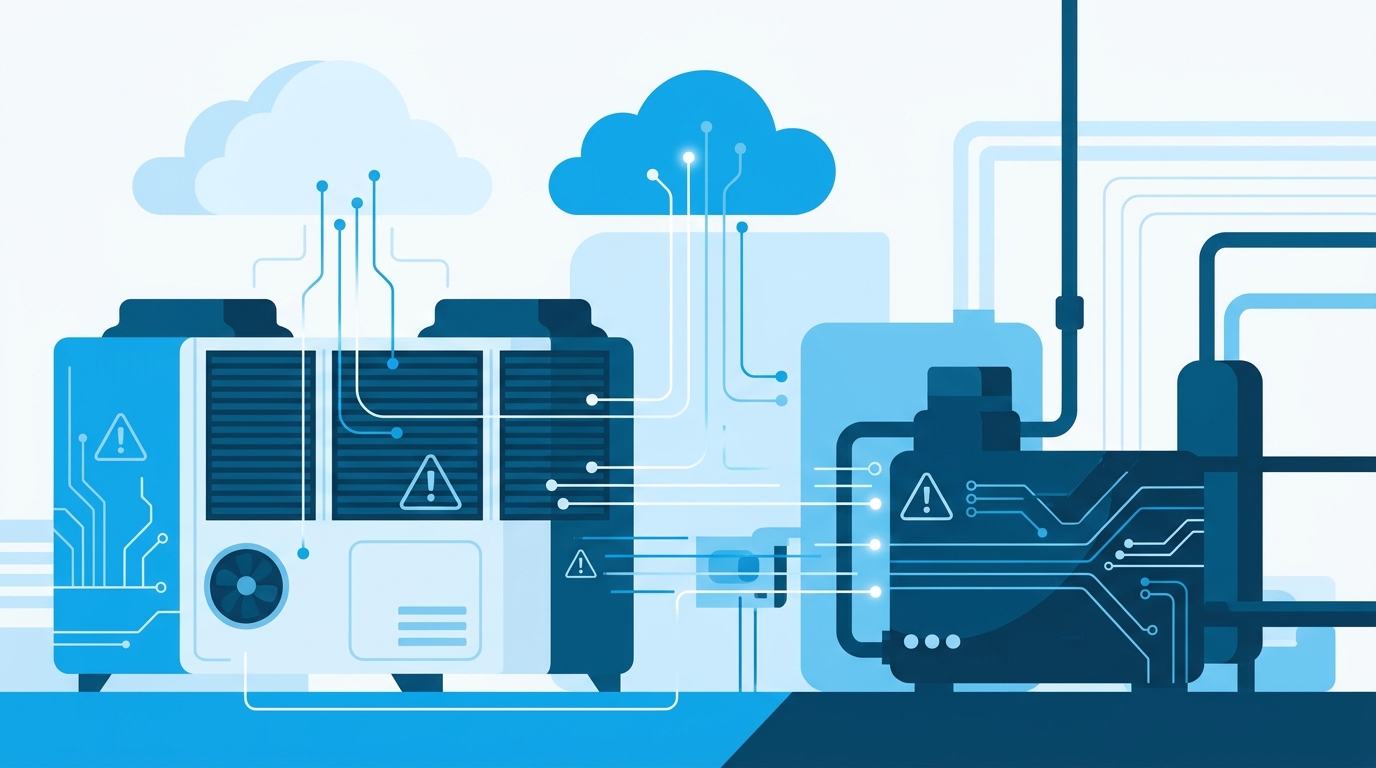
Modern commercial supermarkets run massive refrigeration racks. Walk into any mega-mart and you'll see hundreds of meters of open-deck chillers, glass-door freezers, and backroom blast coolers. Inside those cases sit delicate temperature probes, electronic expansion valves, and compressor racks running on industrial automation protocols. For decades, these controllers ran on isolated RS-485 serial loops speaking raw Modbus RTU. They were dumb, noisy, and disconnected from the outside internet.
Then digital transformation arrived. Retail headquarters demanded real-time energy analytics. ESG reporting required granular power consumption logs. Third-party maintenance contractors demanded remote diagnostics so they wouldn't have to dispatch expensive technician vans for a routine sensor calibration. The solution? Vendors slapped IoT edge gateways on top of the legacy Modbus and BACnet networks, hooking them directly to cloud management platforms.
Crickets. That's usually what you hear when you ask an enterprise IT team who audits those edge gateways. Nobody owns them. IT assumes Facilities manages them. Facilities assumes the refrigeration vendor handles the security. The refrigeration vendor outsources cloud development to the lowest bidder. And that terrifying gap is where this European attack landed.
How the Attack Unfolded: Under the Hood of the Exploit
While forensics teams are still collecting memory dumps from affected sites, preliminary telemetry and incident disclosures reveal a textbook supply chain compromise targeting the centralized fleet management plane.
1. The Centralized SaaS Vector
Refrigeration controllers from major industrial manufacturers (names like Danfoss, Carel, and Epta) rely on centralized management software to coordinate multi-store settings. Store operators don't log into 400 individual IP addresses to tweak defrost timers. Instead, an edge appliance inside each store establishes an outbound tunnel—often via MQTT over TLS or reverse WebSockets—to a vendor-hosted multi-tenant cloud platform.
According to reports filtering through European threat intelligence feeds, the adversaries breached the developer environment of an outsourced facility management software provider. By exploiting a hardcoded API credential inside a staging repository, the attackers pivoted directly into the multi-tenant orchestration backend. From there, they held the master key to thousands of connected grocery stores across Germany, France, and Scandinavia.
2. Malicious Command Payloads Disguised as Eco-Optimization
Here is the sinister part. The attackers didn't drop noisy ransomware on the Windows point-of-sale terminals. They didn't lock the cash registers or display skull-and-crossbones extortion notes. Instead, they pushed a weaponized configuration batch through the vendor's orchestration API.
The payload targeted the temperature setpoint registers and defrost schedules. Under standard operating conditions, a supermarket freezer rack runs at approximately -18°C to -22°C. Modbus registers hold these setpoint parameters as simple 16-bit integers. By issuing a batch write command to Register 40102 (or the proprietary manufacturer equivalent) across thousands of connected rack controllers, the script overrode local target temperatures, pushing them to +14°C. Simultaneously, it triggered forced continuous defrost cycles, energizing electric heating elements designed to melt frost off evaporator coils.
The physical equipment did exactly what the software told it to do: it started heating the freezers. In several distribution centers, cooling fans were systematically disabled. Because the command originated from an authenticated cloud management token, local telemetry alarms were suppressed. Many store managers only realized they were under attack when dairy cartons began leaking onto linoleum floors and ambient humidity fogged glass display doors.
The Critical Flaw: The Illusion of Outbound-Only Security
Every time I consult on remote architecture audits, network administrators tell me the exact same thing: "Our IoT devices are completely safe because our firewalls block all inbound connections. The devices only make outbound connections to our cloud provider."
That logic is fundamentally flawed. In modern industrial stacks, an outbound MQTT or HTTPS connection establishes a bidirectional, persistent control channel. If an attacker compromises the broker at the other end of that tunnel, they don't need an open inbound port on your perimeter firewall. You handed them an open, persistent reverse shell right into the heart of your industrial control network.
Once the central broker is compromised, your edge devices blindly consume whatever payload drops down the queue. If those edge gateways have direct Modbus or CAN bus links to physical hardware without local cryptographic validation or anomaly thresholds, game over. The physical world bends to whatever arbitrary integer the attacker injects into the message queue.
Why Attacking the Cold Chain is the Perfect Asymmetric Strike
Let's look at the broader strategic implications here. Ransomware locking up office spreadsheets is expensive, but it's largely an administrative headache. Sabotaging the food cold chain is an immediate physical disaster. Consider the real-world cascading fallout from this single campaign:
- Immediate Inventory Loss: Perishable inventory cannot be recovered once bacterial thresholds are crossed. Grocers cannot legally discount or salvage thawed meat and dairy. Millions of euros in inventory went straight into industrial dumpsters within six hours.
- Supply Chain Bottlenecks: Supermarkets run on lean, just-in-time logistics. Depleting warehouse and retail cold stock triggers panic-ordering, overwhelming regional distributors who are already operating on razor-thin margins.
- Hardware Burnout: Forcing commercial compressors into erratic cycle loops and continuous defrost cycles causes severe thermal stress. We're already seeing reports of burnt-out compressor heads and tripped sub-breakers that require certified physical technicians to replace.
- Regulatory Sanctions: Health safety agencies across Europe have temporarily halted operations at dozens of stores until every single temperature log can be verified against independent data loggers.
This is economic warfare waged without firing a single missile. An adversary sitting halfway across the globe, armed with a leaked JWT token and an automated Python script, wiped out food reserves across dozens of municipalities in a single morning. That should terrify you.
The Immediate Hardening Playbook for OT and Edge Engineers
If you manage edge gateways, building automation networks, or remote industrial equipment, assume your central management SaaS is already breached. Here are the non-negotiable architectural changes you need to implement today.
1. Enforce Local Hard Ceiling and Floor Constraints
Never permit an external software payload to push a physical parameter beyond safe operating envelopes without a physical, hardwired interlock. If a commercial freezer should never operate above -10°C during active business hours, enforce that constraint in local, read-only firmware on the edge controller itself. Cloud orchestration should suggest optimizations; local firmware must veto insane setpoints.
2. Total Microsegmentation of BMS and Corporate LANs
Refrigeration controllers, HVAC units, and smart lighting must never share a subnet or routing table with store workstations, VoIP phones, or point-of-sale systems. Isolate all building management hardware onto an air-gapped or strictly firewalled VLAN. Block inter-VLAN routing completely. If a chiller gateway needs to talk to a Modbus bridge, that bridge should be the only device visible on its layer-2 domain.
3. Cryptographic Signature Verification for Remote Payloads
Edge devices must reject configuration changes that lack a dual-signature cryptographic token. Cloud brokers should not have unilateral authority to execute parameter overrides. Require changes to critical operational profiles to be signed offline by an internal security engineer using an air-gapped private key (such as an Ed25519 signature verified on the edge gateway before writing to Modbus registers).
4. Deploy Out-of-Band Independent Monitoring
If your primary telemetry stack is compromised, how do you know your freezers are failing? The European retailers affected today trusted the dashboard that the attackers hijacked. You need secondary, battery-operated, out-of-band LoRaWAN temperature sensors transmitting to an independent private gateway. When the cloud dashboard insists the room is -20°C but the LoRaWAN sensor alerts you that it's +12°C, you catch the attack in twenty minutes instead of eight hours later.
The Writing on the Wall
We've spent the past decade connecting every dumb machine on Earth to the public internet in the name of efficiency, energy savings, and centralized convenience. Today, Europe's supermarkets paid the bill.
This attack wasn't an isolated anomaly; it was an inevitable preview of what industrial cyberattacks look like when operational boundaries are ignored. Tomorrow, it won't just be supermarket freezers. It will be municipal water chlorination systems, regional power inverter arrays, and automated pharmaceutical cold chains.
Security can't be treated as an afterthought bolted onto an edge gateway by a third-party vendor. If you build it, if you operate it, and if it touches physical infrastructure, you must defend it with zero-trust rigor from day zero. Cut unauthenticated cloud tunnels, lock down your edge registers, and stop trusting central dashboards blindly. Otherwise, the next time your physical world breaks down, you won't be looking at an engineering malfunction—you'll be looking at an exploit payload.